The Friction Tax: Where Your Profit Goes While Departments Argue
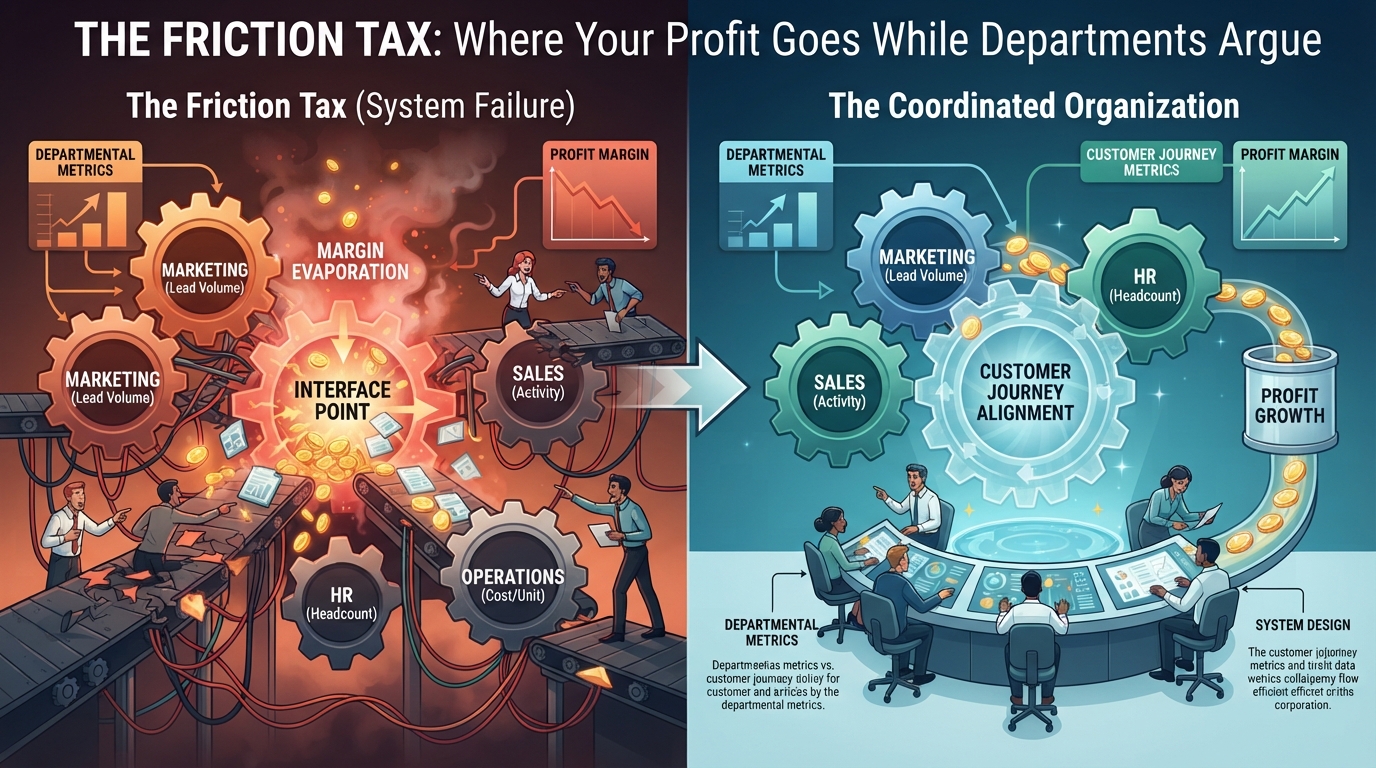
Your marketing team just celebrated a record quarter: 10,000 new leads generated. Your sales team is furious: 80% of those leads are “unqualified garbage.” Your HR team hit their hiring targets, but new hires are burning out in six months. Meanwhile, your profit margin quietly dropped by 4%. Welcome to The Friction Tax.
Most executives obsess over external competition. They watch market share, pricing wars, and competitor moves. But the real margin killer is often inside the building.
When every department optimizes for its own metrics—marketing for lead volume, sales for activity, HR for headcount, operations for cost-per-unit—you create organizational interface friction. Every “handoff” between departments becomes a place where information dies, energy is wasted, and margin evaporates.
This is not a “communication problem.” This is a system design failure.
The Modern Case Study: When Silos Bring Down a Giant
In 2024–2025, Boeing faced the worst crisis in its 100-year history. Door panels fell off mid-flight. Whistleblowers revealed systemic quality failures. The company lost over $11 billion in market value, and the CEO was forced out.
What caused it? Not “bad technology.” Not “market conditions.” Official investigations pointed to a complete breakdown in coordination between engineering, manufacturing, and management. The silos didn’t just slow things down. They created a culture where engineers couldn’t talk to production, where management didn’t listen to quality warnings, and where “meeting the schedule” became more important than “building it right.”
Boeing didn’t fail because it lacked talent or technology. It failed because its internal interfaces were broken. The friction tax became so high that it literally brought the plane down.
The Historical Blueprint: Coordination Beats Technology
This is not a new problem. In the 1920s, Ford was the undisputed king of automobiles. Ford had the best technology (the moving assembly line), the best cost structure, and the most famous brand. But Ford had a rigid silo structure. Every department operated independently, with no coordination mechanism.
Then Alfred P. Sloan Jr. took over General Motors. GM didn’t have better cars. But Sloan created something revolutionary: a system of coordination between divisions. Each brand was autonomous, but Sloan built committee structures and standardized interfaces to ensure they didn’t cannibalize each other and could share best practices.
By 1931, GM had overtaken Ford. Not because of better technology. Because of better interfaces.
⚡ The Interface Friction Audit
You cannot fix interface friction by telling people to “communicate better.” You fix it by redesigning the system. Run this simple framework to find where your profit is hiding:
- 1.
The Handoff Test: Map your core customer journey. How many “handoffs” exist between departments? And how many require the next team to “fix” or “clean up” the previous team’s work? (If sales spends 30% of its time explaining to marketing why leads are bad, you have a friction tax). - 2.
The Metric Misalignment Test: Does each department measure success using metrics that conflict with others? (If marketing is rewarded for “lead volume” but sales for “conversion rate,” you have created a system where they are incentivized to fight). - 3.
The Translator Role Test: Is there anyone whose explicit role is to translate between departments? Someone who understands the language of marketing, sales, and operations, and actively eliminates friction at handoff points? (If not, the friction tax is accumulating invisibly).
The Bottom Line
Your departments are not fighting each other. They are fighting your P&L. Every time marketing blames sales, or sales blames operations, or operations blames HR, that is the sound of your margin evaporating.
True operational excellence is not about optimizing each department in isolation. It is about designing the interfaces between them so that the entire system moves toward the customer, not away from each other.
Join a growing community of leaders who are willing to look beyond the hype, question “best practices,” and confront the uncomfortable truths about their organizations. Let’s go deeper.
Frequently Asked Questions
What is the “Friction Tax” in business?
+
The “Friction Tax” is the invisible loss of profit, time, and energy that occurs when organizational departments operate in silos. When teams optimize only for their own metrics, the handoffs between them become points of failure. Information is lost, rework is required, and overall profit margins quietly evaporate.
Why is organizational interface friction considered a system design failure?
+
It is a system design failure because telling employees to “communicate better” does not fix conflicting incentives. If a company rewards marketing for quantity and sales for quality, the system is designed to create conflict. True operational excellence requires redesigning the interfaces and shared metrics between departments.
How does the “Interface Friction Audit” help identify hidden profit leaks?
+
The Interface Friction Audit evaluates three critical areas: 1. The Handoff Test (identifying where teams must “clean up” previous work), 2. The Metric Misalignment Test (finding conflicting departmental KPIs), and 3. The Translator Role Test (checking if anyone is explicitly responsible for bridging departmental gaps).
How can leaders eliminate silos and build better organizational interfaces?
+
Leaders must stop optimizing departments in isolation and start designing the connections between them. To systematically dismantle these barriers, consider implementing a professional Interface Audit tailored to your company’s specific handoff points. For deeper strategic frameworks, explore the 100 Rules for Business Success: The Baťa Way or The Human Future of Business.