The Illusion of Wealth: Why Modern Productivity is a Trap and How Systemic Leaders Are Reclaiming Their Time
In 1930, John Maynard Keynes predicted that by the 21st century, technological advancements would reduce the human workweek to just 15 hours. Today, in 2026, we possess artificial intelligence, automation, and global connectivity that Keynes could not have fathomed. Yet, we are working longer hours, experiencing record levels of burnout, and feeling less financially secure than previous generations.
This is not a personal failure. It is a systemic design flaw. Welcome to The Illusion of Wealth.
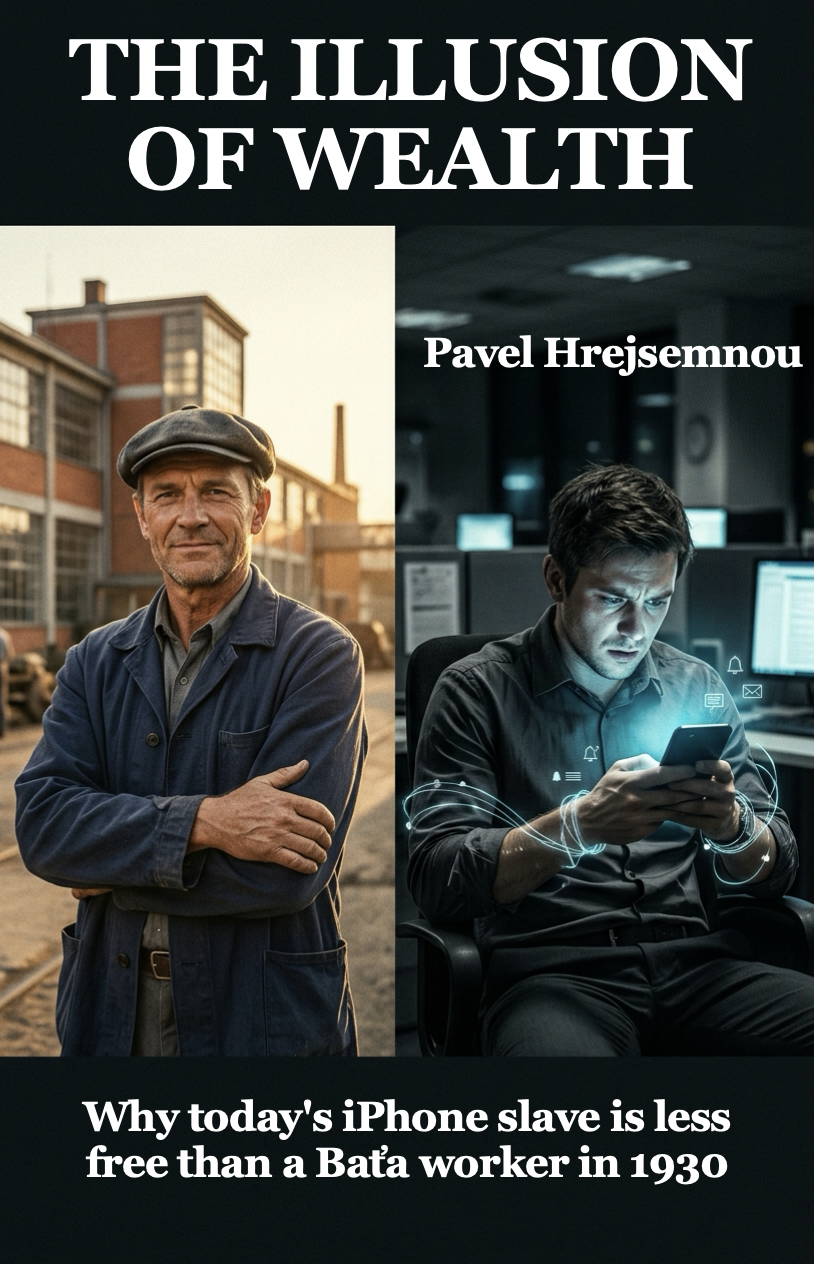
In his groundbreaking new book, The Illusion of Wealth: Why today’s iPhone slave is less free than a Baťa worker in 1930, author and systemic consultant Pavel Hrejsemnou deconstructs the greatest fraud of the modern era: the lie that efficiency and technology were meant to liberate us. Instead, they have been weaponized to extract more output for the same cost.
The Great Decoupling: Productivity vs. Freedom
Until the early 1970s, labor productivity and real wages grew in tandem. If you produced more, you earned more, and you gained more leisure time. Then, the curves diverged. Productivity continued to skyrocket, while real compensation for the average worker stagnated.
Where did the difference go? It was transferred to shareholder dividends, executive compensation, and, most insidiously, into the financialization of assets—most notably, housing. We are no longer paid for our output; we are paid just enough to keep us dependent on the next paycheck, while the true wealth generated by our productivity is captured by the system.
The Three Traps of the Modern Worker
Through a rigorous analysis of historical industrial giants like Tomáš Baťa, Henry Ford, and Ray Kroc, Hrejsemnou identifies three systemic traps that keep modern professionals locked in a cycle of perpetual motion:
- The Two-Income Trap: Housing has transformed from a basic human need into a speculative financial product. What once took one income to secure now requires two, eliminating the margin for savings, investment, or true freedom.
- The Corporate Ladder Illusion: Promotions are marketed as rewards, but they are often just golden handcuffs. Higher titles bring disproportionately higher stress and responsibility, while stripping away the actual hands-on work that provides meaning, leaving you with more money but zero time to spend it.
- The Hyper-Efficiency Paradox: Every time-saving technology (from the washing machine to AI) has not resulted in more leisure. Instead, the "saved" time is immediately reinvested by the system into higher expectations and more tasks. We don't get time back; we get more laundry, more emails, and more meetings.
The Baťa Solution for the AI Age
So, what is the alternative? The answer lies not in working harder, but in changing the fundamental metric of success. Tomáš Baťa, the visionary Czech industrialist, understood a principle that modern economics has forgotten: A satisfied, independent partner is a better investment than a dependent, burned-out wage slave.
Baťa didn’t just pay wages; he built ecosystems. He offered profit-sharing, affordable housing with a clear path to ownership (10–15 years, not 30), and a culture where the worker was a stakeholder, not a line item.
The Illusion of Wealth translates this historical wisdom into a brutal, actionable framework for the 2026 professional. It teaches you how to:
- Shift from Selling Time to Building Assets: Categorize your life into Financial, Intellectual, and Relational assets that work for you, not the other way around.
- Apply the "Baťa Budget" Rule: Allocate your income strictly: 50% to Necessity, 20% to Growth, and 30% to Freedom. If your "necessities" exceed 50%, you are not living; you are servicing the system.
- Redefine Your Career as a Tool, Not a Ladder: Stop asking, "How can I get promoted?" and start asking, "How can I structure my work to maximize my ownership of time?"
Why This Book is a Global Blueprint
The resonance of this message is undeniable. Originally published in Czech, The Illusion of Wealth has already been recognized as a vital systemic critique in multiple languages, including a highly anticipated Portuguese (Brazilian) edition (A Ilusão da Riqueza), proving that the pain points of modern productivity are universal, transcending borders and cultures.
This is not a book of fluffy motivational quotes. It is a systemic dissection of the rules of the game, written by an author with over 30 years of experience as a writer, publisher, and strategic mentor. It is a manual for those who are ready to stop optimizing their own exploitation and start engineering their own liberation.
Ready to Reclaim Your Time?
Stop selling your life for things that aren't worth it. The greatest wealth is not the number in your bank account; it is the unapologetic ownership of your time.
Get "The Illusion of Wealth" Now (PDF & EPUB)
Frequently Asked Questions (FAQ)
What is "The Illusion of Wealth" about?
It is a systemic analysis of why, despite unprecedented technological advancement, modern workers have less time and freedom than previous generations. It provides actionable frameworks based on the historical principles of Tomáš Baťa, Henry Ford, and Ray Kroc to help readers transition from selling time to building real assets.
Is this book relevant for entrepreneurs and CEOs, or just employees?
Both. For employees, it provides a roadmap to escape the two-income trap and redefine career success. For CEOs and founders, it serves as a critical wake-up call on why treating employees as partners (rather than costs) yields higher long-term productivity and retention, as proven by historical data.
In which languages is "The Illusion of Wealth" available?
The book is rapidly expanding its global reach. It is currently available in Czech, English, and Portuguese (Brazilian edition: A Ilusão da Riqueza), with its systemic message resonating across diverse economic landscapes.
How is this different from other personal finance or productivity books?
Unlike typical finance books that focus on budgeting hacks, or productivity books that teach you how to cram more work into your day, this book attacks the root cause: the systemic design of modern work and finance. It teaches you to measure your life in "hours of freedom," not just currency.