The “Quiet Collapse” of Middle Management: Escaping the Illusion of Control
Your dashboards are glowing green. Your revenue projections look solid. Yet, your best customers are quietly leaving, and your frontline teams are burning out. Welcome to the “Quiet Collapse” of middle management.
We were promised that AI, ERP systems, and automated reporting would bring total operational clarity. Instead, for many organizations, they have created a dangerous illusion of control.
In the relentless pursuit of “lean” operations and cost-cutting, we hollowed out the middle layer. We turned former problem-solvers and coaches into data-compilers. Today, middle managers spend the vast majority of their time curating, defending, and sanitizing reports for the C-suite. They spend almost zero time actually removing obstacles for their teams on the front line.
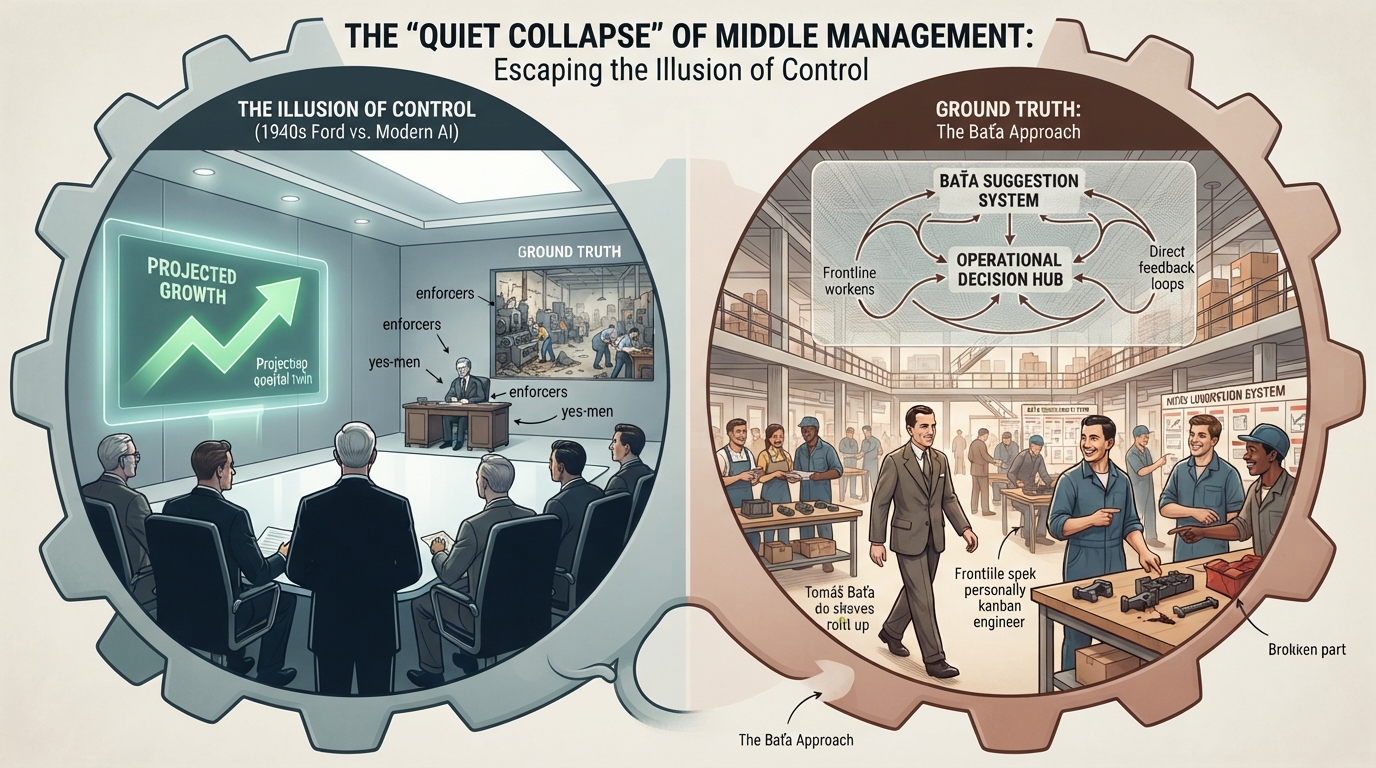
The result is a fatal disconnect: Leadership sees a flawless, AI-polished digital twin of the business, while the physical reality on the shop floor, in the warehouse, or in sales quietly disintegrates.
The Historical Warning: Ground Truth vs. Filtered Illusions
History offers a brutal warning about this exact delusion. Tomáš Baťa knew that truth is never found in a sanitized summary. He walked the factory floor daily. He implemented a suggestion system that empowered the frontline to report process failures, not just output numbers. He knew the real KPIs were in the hands of the workers, not on a director’s desk.
Conversely, look at the later years of Henry Ford. As he aged, he isolated himself in his office. He surrounded himself with enforcers and yes-men who systematically filtered out bad news to protect their own positions. The internal reports of the 1940s looked perfectly fine. But the ground truth was ignored, and the company bled market share to competitors who were actually listening to their customers and workers.
Ford proved that when leadership becomes dependent on filtered reports, the organization rots from the inside out.
⚡ The Ground-Truth Audit
You cannot manage a physical reality with purely digital illusions. If you want to know if your company is suffering from the Quiet Collapse, run this simple framework with your leadership team:
- 1.
The Lagging vs. Leading Test: Are your dashboards showing you what happened last month (revenue, output), or what is breaking today (customer workarounds, employee frustration, hidden bottlenecks)? - 2.
The “No-Filter” Test: When was the last time a C-level executive spoke directly to a frontline employee without their middle manager present, specifically to ask: “What is slowing you down, and what stupid rule can we eliminate?” - 3.
The Middle Manager Value Test: Is your middle management spending 80% of their time compiling reports for you, or 80% of their time removing obstacles for their teams?
The Bottom Line
A dashboard is a rearview mirror. It tells you where you have been, not what is hiding in the blind spot right now. True control doesn’t come from more data; it comes from unfiltered access to reality.
Ready to look beyond the digital illusion?
Understand the historical mechanics of true operational freedom, resilience, and wealth. Explore the deeper frameworks in The Human Future of Business or the timeless principles in 100 Rules for Business Success: The Baťa Way.
Frequently Asked Questions
What is the “Quiet Collapse” of middle management?
+
The “Quiet Collapse” refers to the hollowing out of the middle management layer, where former problem-solvers and coaches are reduced to “data-compilers.” Instead of removing obstacles for frontline teams, they spend the majority of their time curating and sanitizing reports for the C-suite, creating a fatal disconnect between leadership’s digital view and physical reality.
Why do automated dashboards create an “illusion of control”?
+
Dashboards are essentially rearview mirrors. They show lagging indicators (what happened last month, like revenue or output) but fail to capture leading indicators of systemic rot, such as customer workarounds, employee frustration, or hidden bottlenecks. Relying solely on polished data creates a false sense of security while the actual business disintegrates.
How does the “Ground-Truth Audit” help leadership reconnect with reality?
+
The Ground-Truth Audit forces leaders to ask three critical questions: 1. The Lagging vs. Leading Test (are we seeing what’s breaking today?), 2. The “No-Filter” Test (do executives speak directly to frontline workers without managers present?), and 3. The Middle Manager Value Test (are managers removing obstacles or just compiling reports?).
How can companies prevent organizational rot and empower frontline teams?
+
True control comes from unfiltered access to reality, not more data. Leaders must shift their focus from sanitized summaries to direct engagement. For historical blueprints on empowering the frontline and building resilient systems, explore 100 Rules for Business Success: The Baťa Way or the comprehensive guide The Human Future of Business.