The Skill-Gap Trap: Making $100M Decisions with a 1990s Operating System
There is a silent bottleneck strangling corporate innovation today. It is not a lack of technology, and it is not a lack of talent. It is the executive boardroom.
We often hear about a “tech skill gap” in leadership. But let’s be clear: your board members do not need to know how to code, architect a neural network, or manage a Jira board.
The real gap is Strategic Velocity.
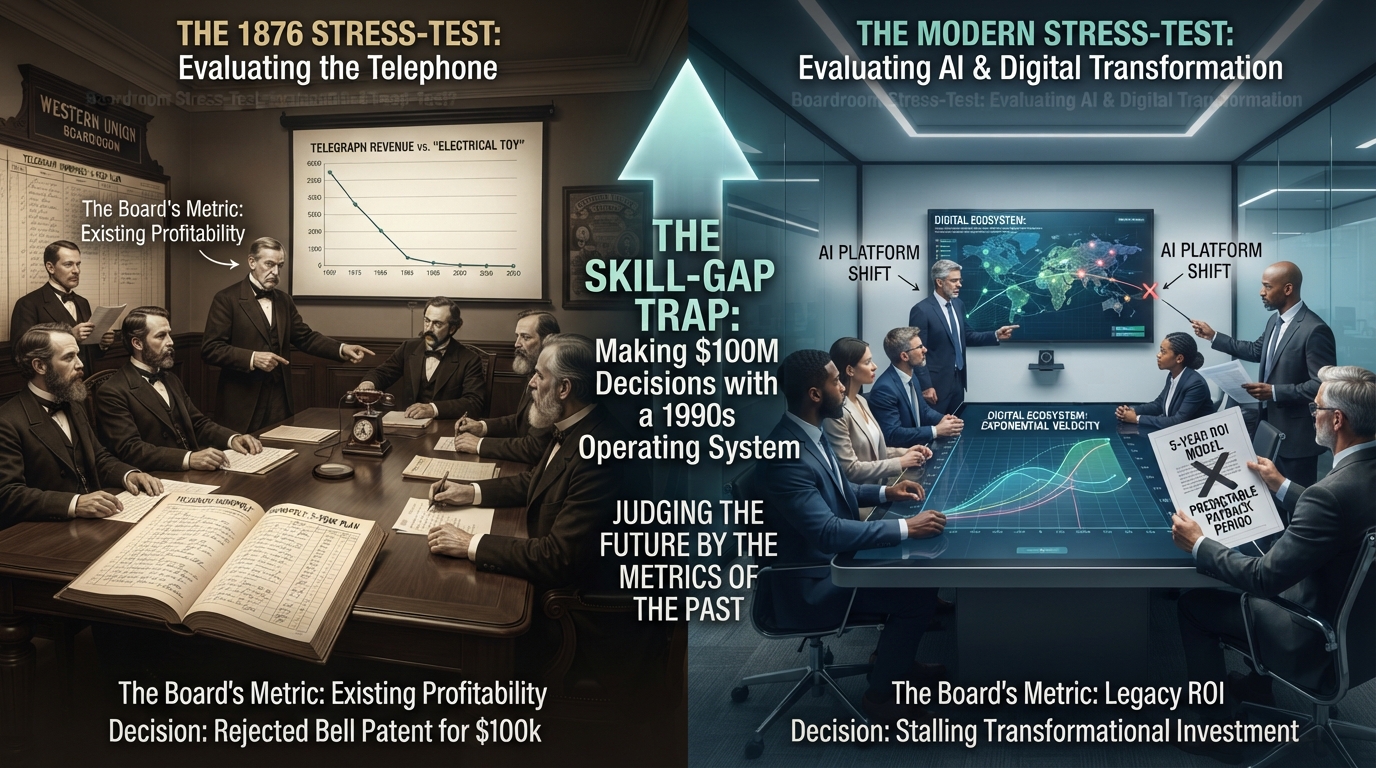
Too many boards evaluate exponential technologies, digital M&A, and platform shifts using linear, 5-year ROI models and rigid risk matrices designed for purchasing a legacy manufacturing line or an on-premise ERP system in 1998. They demand absolute certainty and predictable payback periods in an environment defined by speed, iteration, and systemic disruption.
The Historical Warning: Judging the Future by the Metrics of the Past
History offers a brutal, well-documented warning about this exact delusion. In 1876, Alexander Graham Bell offered Western Union the patent for the telephone for $100,000. The board of directors, composed of brilliant men who had built a global telegraph monopoly, formally rejected the offer.
Their official meeting minutes dismissed the telephone as an “electrical toy” with no commercial value compared to their established, highly profitable telegraph network.
They did not lack data. They lacked the operating system to evaluate a paradigm shift. They judged a completely new communication ecosystem using the margin and infrastructure metrics of their legacy monopoly. The result is one of the most famous strategic blunders in business history.
Today, boards are making the exact same mistake. They evaluate AI or digital transformation not by asking “How does this change the rules of our industry?” but by asking “How does this fit into our existing 5-year financial plan?”
⚡ The Boardroom Stress-Test
You cannot manage exponential change with linear tools. If your board is preparing to approve a major technological or strategic investment, run this simple framework before the vote:
- 1.
The Velocity Test: Are we evaluating this investment using a linear, multi-year ROI model, or are we accounting for exponential adoption curves and rapidly shifting cost structures? (If you demand a 5-year payback period for a core tech shift, the technology will be obsolete before you break even). - 2.
The Cannibalization Test: Does our risk assessment matrix explicitly ask: “If this new technology works perfectly, which of our current, highly profitable legacy products or processes will it destroy?” (If the answer is “none,” you are likely funding an incremental improvement, not a transformation). - 3.
The Translator Test: Do we have at least one person in the room whose explicit role is not to be an “IT expert,” but to translate technological velocity into business strategy? Someone who doesn’t ask “How does it work?” but “How does this alter our competitive moat in 18 months?”
The Bottom Line
A board’s primary job is not to micromanage technology, but to ensure the organization’s mental models are upgraded to match the reality of the market. Evaluating tomorrow’s disruptions with yesterday’s rulers is a guaranteed path to obsolescence.
Ready to look beyond legacy thinking?
Understand the historical mechanics of true operational resilience and strategic foresight. Explore the deeper frameworks in The Human Future of Business or the strategic principles in 100 Rules for Business Success: The Baťa Way.
Frequently Asked Questions
What is the “Skill-Gap Trap” in executive boards?
+
The “Skill-Gap Trap” is the misconception that board members need technical expertise (like coding or IT management) to govern modern companies. The real gap is a lack of Strategic Velocity—the inability to evaluate exponential technologies and paradigm shifts because the board is still using linear, 20th-century financial models and risk matrices.
Why do traditional 5-year ROI models fail for exponential technologies?
+
Exponential technologies evolve at a pace that renders multi-year linear projections obsolete. Demanding a predictable 5-year payback period for a core technological shift ignores rapidly shifting cost structures and adoption curves. By the time a linear model “breaks even,” the technology and the market landscape have already fundamentally changed.
What is the “Boardroom Stress-Test” and how does it prevent strategic blunders?
+
The Boardroom Stress-Test is a 3-step framework to evaluate major investments: 1. The Velocity Test (checking for exponential vs. linear evaluation), 2. The Cannibalization Test (identifying if the new tech will disrupt existing profitable lines, which is a sign of true transformation), and 3. The Translator Test (ensuring someone in the room can translate technological speed into business strategy).
How can organizations upgrade their board’s strategic foresight?
+
Boards must shift from micromanaging technology to upgrading their mental models. Leaders can achieve this by studying historical case studies of systemic disruption and adopting frameworks built for the modern era. For deeper insights, explore The Human Future of Business or the timeless strategic principles in 100 Rules for Business Success: The Baťa Way.