The Missing Blueprint: What Elon Musk Can Learn from Tomáš Baťa (1927)
Henry Ford solved manufacturing. Ray Kroc solved scaling. But Tomáš Baťa solved the hardest problem of all: How to make 10,000 employees think and act like owners.
Elon Musk is reinventing the wheel. He’s optimizing rockets, electric cars, and neural interfaces. But as Tesla and SpaceX scale into massive organizations, they’re hitting the same wall that every industrial giant hits: bureaucracy, organizational bloat, and the disconnect between leadership and the factory floor.
Musk knows this. He constantly fights “manufacturing hell” and top-down management. But he’s looking only forward, not backward. He’s missing a blueprint that was written 100 years ago by a Czech industrialist who built a global empire across 30 countries without venture capital, without social media, and without engineers from MIT.
His name was Tomáš Baťa. And he solved the human factor problem that Musk is still struggling with today.
The 4 Empire Builders: Each Solved One Piece of the Puzzle
Scaling a company from 10 to 100,000 employees isn’t about working harder. It’s about solving four distinct problems. Four men, in four different eras, each solved one of these problems. Understanding all four is the cheat code for building an enduring organization.
Henry Ford (1913)
The Problem He Solved: Manufacturing
The Solution: The assembly line. Ford didn’t invent the car, he invented how to make cars at scale. He reduced production time from 12 hours to 90 minutes.
The Principle: “Standardize the process, then optimize relentlessly.”
Ray Kroc (1955)
The Problem He Solved: Scaling & Standardization
The Solution: The franchise model. Kroc took McDonald’s from 1 restaurant to 10,000+ by creating a system so precise that any teenager could execute it perfectly.
The Principle: “If you can’t systematize it, you can’t scale it.”
Tomáš Baťa (1927)
The Problem He Solved: The Human Factor
The Solution: Decentralized ownership. Baťa made every employee an entrepreneur. Each workshop was a profit center. Workers shared directly in profits (and losses). Zero middle-management bloat.
The Principle: “Every employee is an entrepreneur. Every workshop is a business.”
Elon Musk (2026)
The Problem He’s Solving: Vision & Disruption
The Solution: First-principles thinking. Musk is combining Ford’s manufacturing, Kroc’s scaling, and his own vision to disrupt multiple industries simultaneously.
The Missing Piece: Baťa’s human-centric accountability model.
The Problem Musk is Facing (That Baťa Solved in 1927)
As Tesla grew from a startup to a global manufacturer with 100,000+ employees, Musk started hitting the same wall that every industrial giant hits: organizational bloat.
He’s publicly complained about “manufacturing hell,” excessive meetings, and the disconnect between engineering and production. He’s even slept on factory floors to stay connected to the front lines.
But here’s the problem: Musk is trying to solve this with more top-down control, more direct management, more “hardcore” culture. He’s applying Ford’s 1913 playbook to a 2026 problem. And it’s not working.
What Baťa Did Differently
In 1927, Tomáš Baťa had 30,000 employees across 30 countries. He didn’t have Slack, Zoom, or AI. But he had something more powerful: a system that made every employee think and act like an owner.
Baťa’s 3-Part System (The Missing Blueprint)
- Decentralized Profit Centers: Each workshop (50-100 people) was an independent business unit. They had their own P&L. They knew their costs, their revenue, their profit. Every single day.
- Direct Profit Sharing: Workers didn’t just get a salary. They got a direct share of their workshop’s profit. If the workshop saved money, workers earned more. If it wasted money, workers earned less. Radical accountability.
- Zero Middle Management: No regional managers, no VPs of operations, no “leadership layers.” Each workshop leader reported directly to headquarters. No bureaucracy. No politics. Just results.
The result? Baťa’s employees were more motivated, more efficient, and more innovative than any competitor. They didn’t need to be micromanaged because they were owners, not employees.
The Free Blueprint for Musk (And Every Scaling Company)
Elon, if you’re reading this (or if your team is), here’s the blueprint you’re missing. It’s not theory. It’s a system that worked for 30,000 people in 1927, and it will work for 100,000 people in 2026.
Step 1: Break Tesla into 1,000 Profit Centers
Don’t manage 100,000 people. Manage 1,000 teams of 100. Each team has its own P&L. Each team knows their numbers daily. Each team is accountable for their own results.
Step 2: Implement Direct Profit Sharing
Give every team a direct financial stake in their results. If they save $1M, they keep 10%. If they waste $1M, their bonus goes to zero. Make them owners, not employees.
Step 3: Eliminate Middle Management
Fire the VPs. Fire the regional managers. Fire the “directors of synergy.” Each team leader reports directly to you (or your C-suite). No layers. No bureaucracy. Just results.
This isn’t nostalgia. This is a battle-tested system that built one of the largest industrial empires in history. And it’s free. You don’t need to pay me. You don’t need to hire a consultant. Just read Baťa’s principles and apply them.
Why This Matters (Beyond Tesla)
This isn’t just about Tesla or SpaceX. Every company that scales past 1,000 employees hits this wall. The startup culture dies. Bureaucracy takes over. Innovation slows down. Employees stop caring.
The solution isn’t more culture decks, more all-hands meetings, or more “vision statements.” The solution is a system that makes every employee an owner. That’s what Baťa figured out 100 years ago. And it’s what every scaling company needs to figure out today.
Want the Complete Blueprint?
I’ve mapped out the complete “100 Rules of Empire Builders” – connecting Ford, Kroc, Baťa, and Musk into a single, actionable framework. This isn’t theory. It’s a field manual for building enduring organizations.
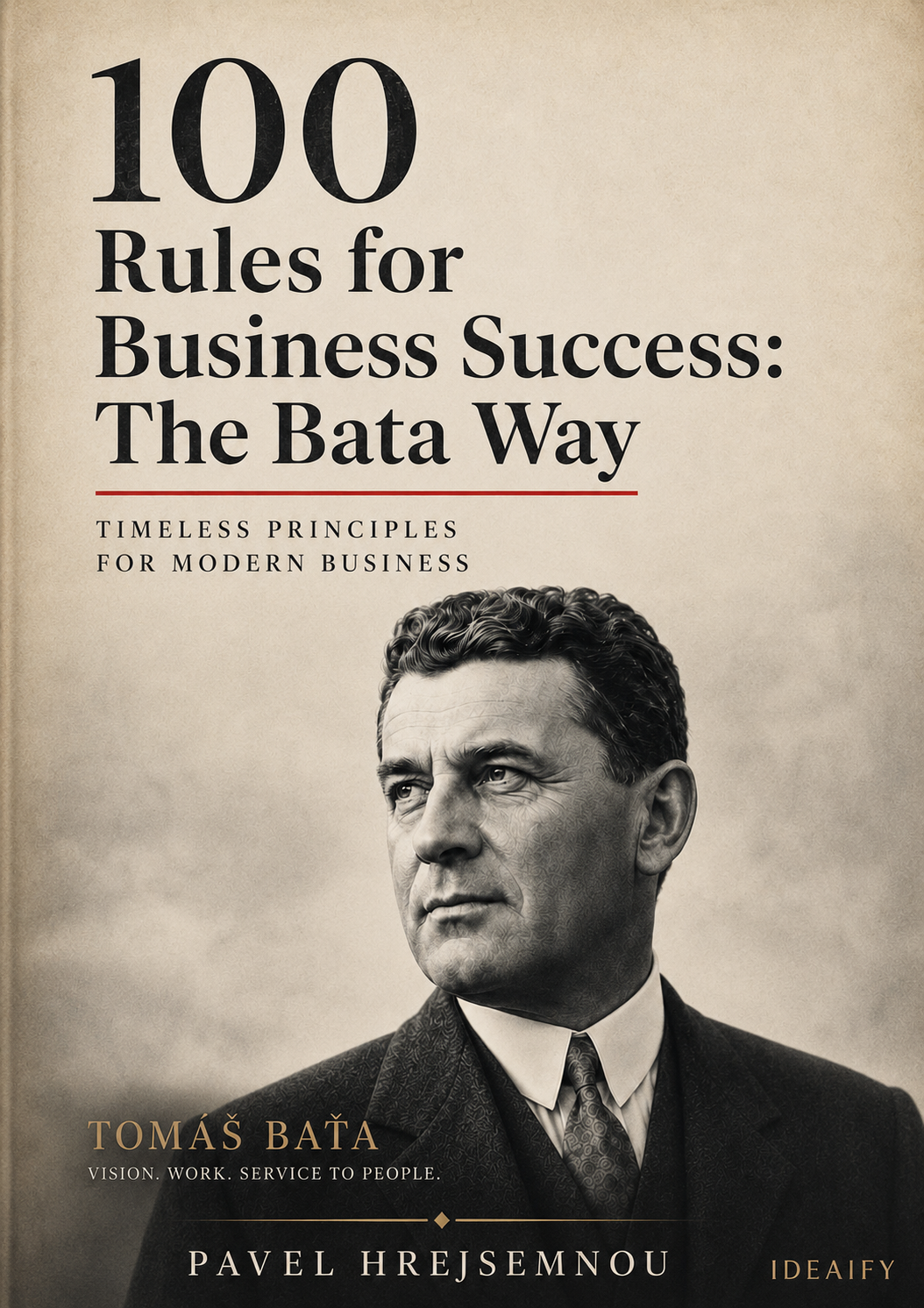
📚 Get the Book: 100 Rules According to Tomáš Baťa
Available in English, Czech, German, Japanese, and more.
“If you want to build a great company, build yourself first.”
– Tomáš Baťa (1927)
About the Author
Pavel Hrejsemnou is a Czech author, strategic mentor, and visual storyteller. He has authored 100+ editions across 6 languages, including the trilogy “100 Rules: Empire Builders” – a comprehensive guide to building enduring organizations based on the principles of Ford, Kroc, and Baťa. He helps companies eliminate organizational friction through his Interface Audit methodology.